Jun 3, 2026
Annual Prest Lecture hosts Rev. Dr. Anastasia Holman from the Indiana University Health System
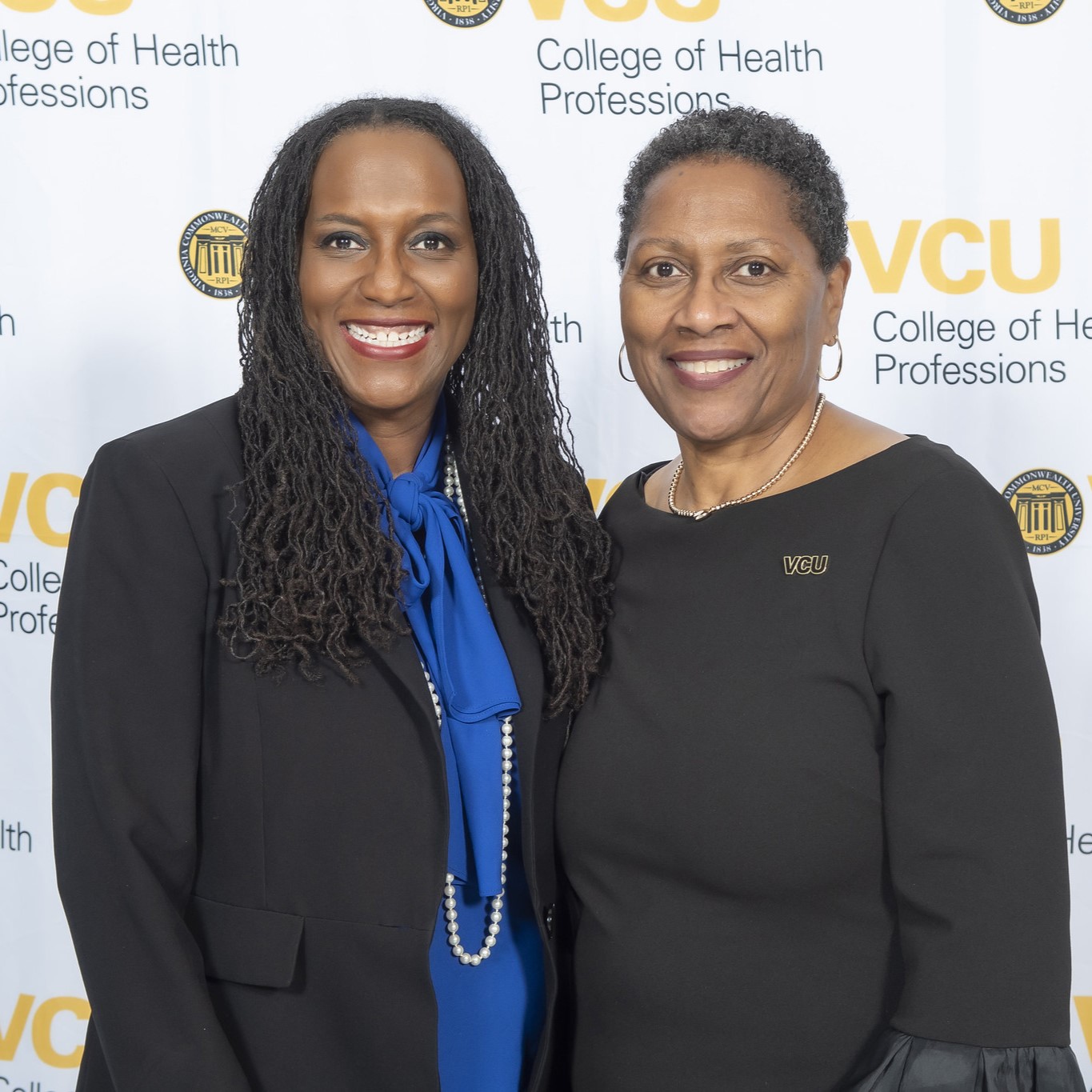
In April, the Virginia Commonwealth University College of Health Professions Patient Counseling Department held its annual Prest Lecture, with Rev. Dr. Anastasia Holman, director of Chaplaincy Education for the Indiana University (IU) Health System, as the guest lecturer. Holman oversees the Clinical Pastoral Education program for the IU Health System and is also the co-faculty for the Religion and Spirituality in Medicine Scholarly Concentration at the IU School of Medicine.
Holman began the lecture by thanking staff and faculty for arranging her invitation and her return to CHP after she was unable to attend last year. Her speech was titled Bridging Tradition and Innovation: Leading Spiritual Care Practice Through Education, Research and Vision.
“This sits at the very heart of our profession and our vocation, how we bridge the deep sacred traditions of spiritual care with the bold, necessary innovations shaping health care,” said Holman. “Today, we're living in a moment where health care is being reshaped at every level, technologically, culturally, spiritually, and morally. And spiritual care sits right at the crossroads of all of this. We carry ancient practices of presence, meaning making, and compassion, while also navigating new demands for data integration, equity, and innovation.”
Holman said the pillars of education, research, and vision not only help honor the traditions that have formed in the field, but are needed in every aspect of ministry and work. She also said the future of spiritual care will be shaped by people who can hold on to both tradition and education.
“Tradition is defined by the transmission of customs or beliefs from generation to generation, and innovation is the process of changing something that's already established by introducing new methods,” she said. “But we know that by bridging the two, there has to be some kind of balance.”
Holman added that the core of her work in spiritual care is about presence, with the ministry rooted in listening to people while serving as keepers of the rituals. Spiritual health and practices are not threatened by innovation but strengthened by it.
“Our tradition teaches us that presence is powerful [and] Story is sacred,” she said. “Suffering requires accompaniment, not solutions. Healing is relational, not transactional. And every person carries inherent dignity and worth.”
Spiritual care evolution and artificial intelligence
As for how spiritual care should evolve, Holman says it is not a question of whether it should change, but rather how it should evolve with integrity. For her, it is critical that spiritual care changes in ways that honor lineage while "courageously shaping the future.” She notes that wisdom and traditions have survived because it humanizes and connect to something larger than ourselves.
“In health care, environments, and in societies and in our spheres of fluent influences, they're rapidly changing [and] Becoming more digital,” she said. “And transactional tradition reminds us that people are not data points. People are more than numbers and dollars.”
Holman acknowledges that artificial intelligence will need to be learned, as it is not going away anytime soon. However, as spiritual caregivers, it is important to learn about newer forms of technology to keep pace with the modern world, while incorporating spiritual taxonomy into it.
Furthering education
While Holman noted that the work requires building relationships, interconnectedness and community to thrive, there are several steps that scholar practitioners can take to elevate their work.
The first step is education, and preparing the next generation of spiritual care leaders with “rigor, cultural humility, and trauma-informed formation.” She said this will require those in the field to continuously learn and not be stagnant. Holman also said that for those looking to advance and innovate, do not wait for anyone to invite you; just knock on the door.
“We have to write our own story, our journeys and our experiences. And I think we're starting to do that now. I'm seeing more research happening where chaplains are involved in the process,” she said.
Holman concluded that more education will drive advancement, but it needs collaborations and partnerships.
“We don't have to have a Ph.D. to do a research project. We do have to have curiosity. We do have to build partnerships. We do have to engage in measurement, evaluation, and a willingness to ask what difference does this make?” she said.
The lecture series was established in 1972 by Mary Naomi Prest as a tribute to her husband, A. Patrick L. Prest, a key figure in providing financial guidance to ACPE. The lecture series aims to build dialogue and learning by inviting scholars in spiritual care and ethics to campus. The next Prest Lecture is scheduled for April 9, 2027.