Dec 3, 2025
CHP simulation lab upgrades raise the bar for PT and OT training
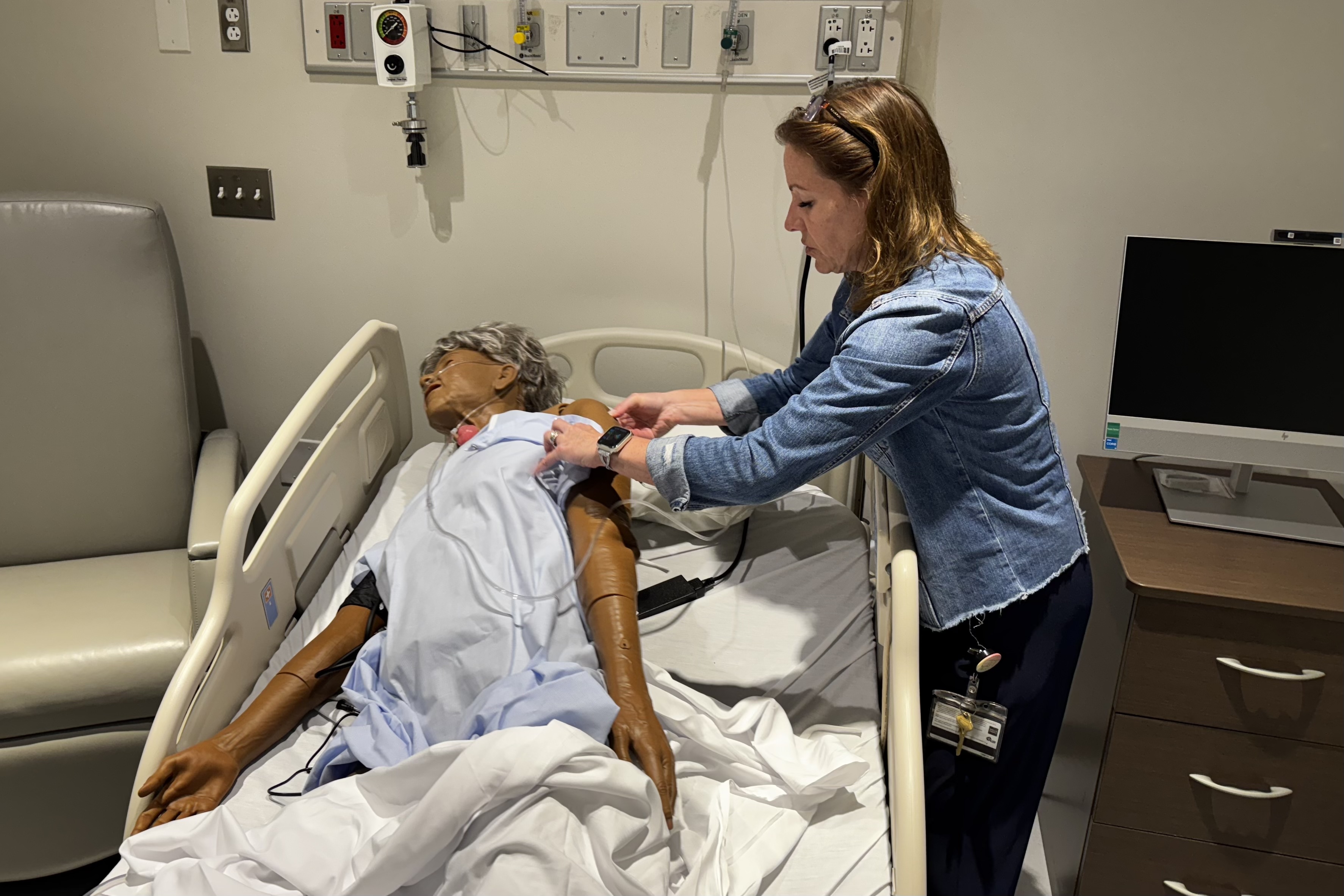
When they stepped into the simulation lab on the second floor of the College of Health Professions this fall, physical and occupational therapy students found it had undergone considerable changes. Thanks to a $108,000 allocation from the Higher Education Equipment Trust Fund, it now features a more immersive, hands-on training environment that reflects the evolving demands of modern health care.
The simulation lab, open to all CHP students, is anchored by four hospital-style rooms equipped to replicate clinical environments ranging from inpatient rehab to skilled nursing. Recent enhancements include computer monitors displaying different patient needs in each room, communication boards, equipment sound effects and a state-of-the-art mannequin.
The mannequin is the centerpiece of the upgrades. It’s lifelike in more ways than one, and in addition to being high tech, it’s able to simulate a wide range of patient conditions. Weighing about 170 pounds, it includes fully movable joints, realistic skin texture and even variable pupil dilations. It can be catheterized, display different stages of tracheal healing and simulate various neurological conditions such as nystagmus, or rapid, uncontrollable eye movements.
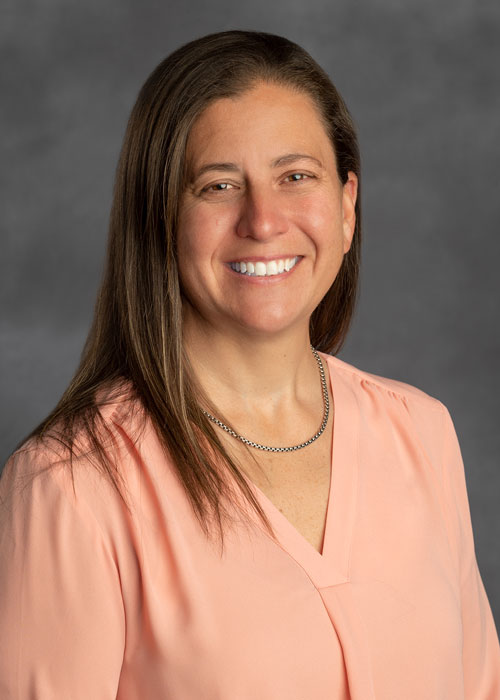
Both PT and OT students benefit from the mannequin’s strategic design, with its articulating joints being most important for physical therapy purposes. “Having a mannequin that isn’t able to help at all with getting it out of bed or across the room will help train our students better for dependent lifting and transfers,” said Katie Shaab, PT, DPT, Ph.D., assistant professor of physical therapy.
Monitors connect to the mannequin and simulate vitals, such as oxygen flow and cardiac output, along with auditory cues that make the experience even more realistic for students. Shaab and other instructors can manipulate simulated vitals remotely. “Previously, I had to stand in the room and verbally tell them the patient’s vital signs,” she said. “Now, it’s the monitor telling them what’s going on, instead of me being a third party.”
First-year PT students are spending this semester in the lab learning foundational mobility skills, such as safe transfers and ambulation. In the spring, Shaab plans to bring students back into the lab to layer in more complexities, which is when the future practitioners will be accessing vital signs and using other technology tools. This work will culminate in a set of intensive, multi-hour simulations with live standardized patients – often retired or current physical therapists – at the end of the academic year as students prepare for clinical rotations.
Each hospital-style room is wired with cameras and microphones, allowing instructors to monitor and record sessions from a central control room. During end-of-year simulations, one group of students performs the assigned tasks while another watches a live feed. Afterward, both groups, the faculty and the standardized patient hold a debriefing session that can last up to an hour to discuss what went well and identify opportunities for improvement.
Providing another layer of realism is a new room that mimics areas of hospital units where therapists document patient care. Here, students will learn to transition directly from patient interaction to documentation, just as they would in a clinical setting.
Shaab anticipates the upgrades will benefit other parts of the PT curriculum. “Now that we simulate vital signs, we can use this resource for cardiopulmonary instruction and neurophysical therapy,” she said. “We’re adding more neurologic content to our curriculum, and this space will be really vital to building it out.”
To help students take ownership of the space, Shaab and her colleagues hosted a naming contest for the new mannequin. PT and OT students were invited to vote on a gender-neutral name from a curated list, adding a sense of cross-department camaraderie to the learning experience. (They landed on Charlie.) “The specific roles and responsibilities of both physical and occupational therapists have to be coordinated to give a patient a good experience in the end,” Shaab said. “That never happened before we moved into the CHP building.”
Ultimately, the upgrades are about preparing students not just to pass assessments but to thrive in high-pressure health care environments. Shaab noted that her second-year PT students, who learned in the simulation lab using the “old-school method” of verbally-stated vitals, are “severely jealous” of their successors. “They’re like, ‘We want to come back to the sim lab. We want to see how it all works!’”