May 22, 2026
Delivering pediatric PT through a trauma-informed lens
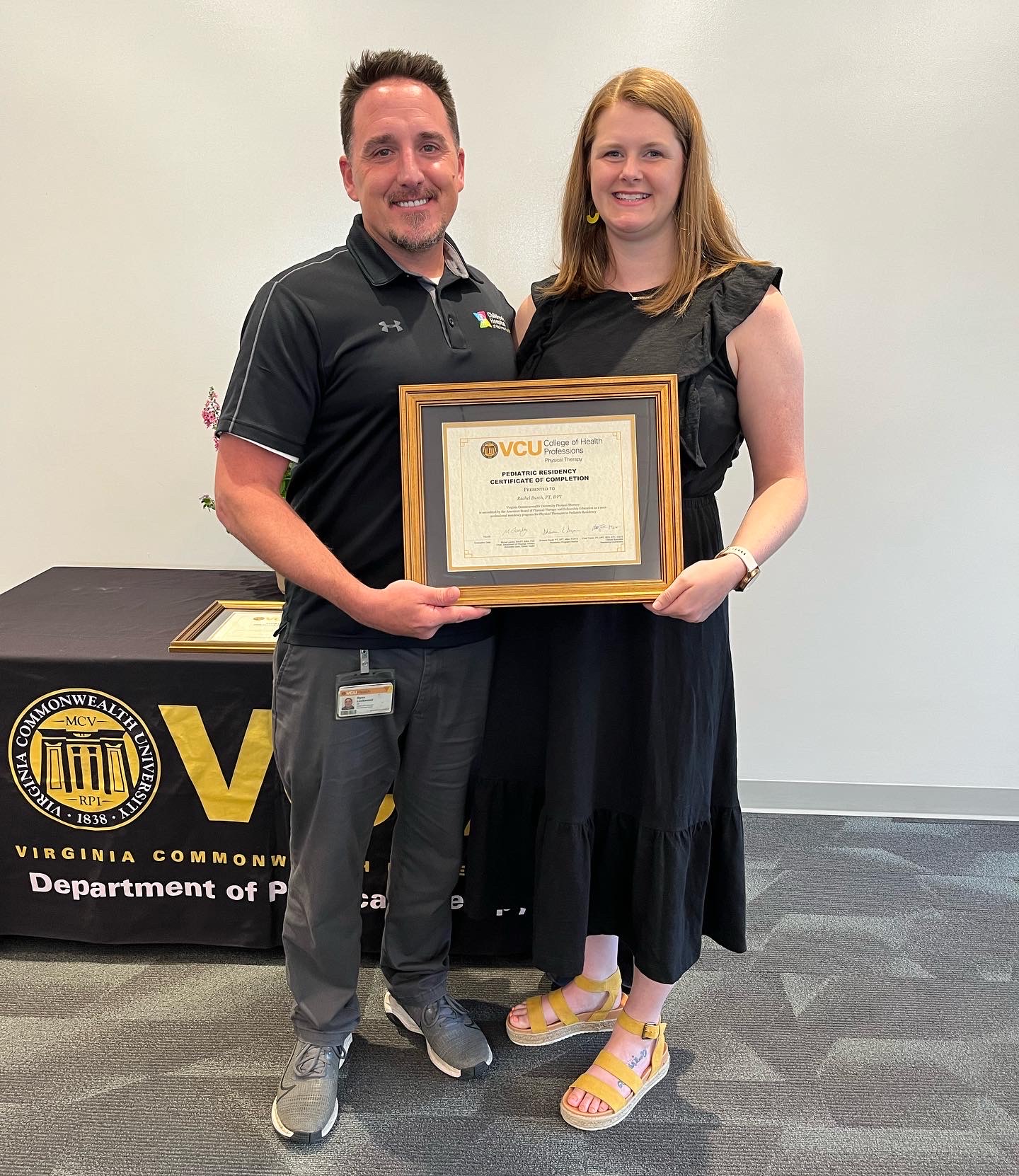
After graduating from Georgia State University with an art history degree, Rachel Burch Belcher found herself at a crossroads. She had planned to pursue museum education but, after being waitlisted for graduate school, took a job as a nanny. The role brought her into the life of a young child with significant developmental delays, a turning point she didn’t yet recognize.
The child required multiple therapies each week, and Belcher quickly became essential in transporting him to appointments and continuing therapy exercises at home. “I found myself loving the physical therapy side of things the most,” she said. “Helping him learn how to crawl, pull to stand, walk – it was fun. It felt meaningful.”
In fact, the child’s physical therapist noticed Belcher’s natural ability and encouraged her to consider the profession. At first, she brushed it off, but the idea stuck. Over time, she discovered a calling that led her to build a new academic foundation, taking science prerequisites while working full-time before enrolling at the University of Alabama at Birmingham to earn her DPT.
From the start, caring for young clients felt like home. However, it wasn’t until her Pediatric PT Residency at Virginia Commonwealth University that her work took on a deeper dimension with trauma-informed care.
“I didn’t have education in school about trauma-informed care,” Belcher said. “But I was encountering all these behaviors – fear, resistance, anger – that were clearly affecting how I could treat patients.”
Asking the right questions

Those encounters pushed her to ask a different set of questions. Instead of focusing solely on physical impairments, she began to consider the emotional and psychological experiences shaping each patient’s response to care.
One 5-year-old patient, in particular, changed everything.
Recovering from severe burns caused by abuse, the young girl was alone in an unfamiliar hospital environment, in pain and deeply distrustful of the adults around her. She had also been diagnosed with autism, though Belcher began to question whether trauma might better explain many of her behaviors.
“She didn’t trust anybody,” said Belcher, who treated her as a resident. “She was scared. She would scream, hit, refuse everything. But when she felt safe, she was bubbly and social. That disconnect made me think, ‘What are we missing here?’”
For Belcher, the challenge wasn’t just helping the child regain mobility; it was building trust in an environment that felt threatening. Progress depended on understanding the child’s fear, not pushing past it.
That experience crystallized a broader truth that trauma is not always visible and often carries layers.
“Trauma can be a lot of things,” Belcher explained. “We think of big events – accidents, injuries – but it can also be chronic stress, family instability, a new diagnosis. And we’re often seeing patients at the hardest moment of their lives.”
In response, Belcher immersed herself in trauma-informed care, helping develop educational materials and training programs at VCU, where she completed her residency in 2023. She contributed to online learning modules for health care providers and collaborated with the Academy of Pediatric Physical Therapy to create evidence-based fact sheets – tools designed to make trauma-informed approaches accessible and actionable.
Practicing trauma-informed care
At its core, trauma-informed care, as Belcher sees it, is simple yet transformative.
“It’s approaching every patient with the assumption that they’ve been through something,” she said. “It’s being nonjudgmental, understanding behaviors in context and asking, ‘What does this person need right now to feel safe and supported?’”
That mindset extends beyond patients to families and even to health care providers themselves. In pediatric settings, for example, parents might appear disengaged or overwhelmed, but Belcher has learned not to assume indifference.
“Sometimes, a parent steps back not because they don’t care, but because they can’t handle it in that moment,” she said. “Giving them permission to step out of a room can actually be part of supporting them.”
Belcher has also seen how trauma affects clinicians, especially in high-intensity environments such as oncology units, where providers form close bonds with patients who may not survive.
“We’re part of that experience, too,” she said. “We carry those relationships and those losses.”
Today, Belcher brings that perspective to her work at Lucile Packard Children’s Hospital Stanford, where she treats pediatric patients in acute-care settings. Her days are still filled with the physical challenges that first drew her to PT – helping children regain movement, strength and independence. But her approach is now grounded in something deeper: the belief that trauma-informed care isn’t a separate task layered onto treatment, but the foundation of treatment.
For Belcher, it comes back to the same lesson she learned years ago as a nanny – meeting children where they are, with patience, empathy and a willingness to see beyond the surface.
“I think a lot of times, we just need to pause,” she said. “Take a step back and ask, ‘What’s really going on here?’ Because when you understand that, everything about how you care for someone can change.”