Jul 6, 2026
Inaugural Transforming Chaplaincy members look back on 10 years of the organization and its future
The field of chaplaincy is becoming increasingly research-focused, and one catalyst has been Transforming Chaplaincy (TC), a program designed to promote evidence-based spiritual care and blend research with professional practice. Established at Rush University in Chicago a decade ago, TC has several faculty members of Virginia Commonwealth University’s Department of Patient Counseling who have led and championed initiatives within TC. VCU faculty have been integral to the organization's development and growth, and are helping to shape its future.
The organization was established in 2015 through a generous grant from the John Templeton Foundation with contributions by multiple professional chaplaincy and education organizations. Dr. George Fitchett, a professor in the Department of Religion, Health and Human Values at Rush University Medical Center, and Dr. Wendy Cadge, now President of Bryn Mawr College, served as co-Principal Investigators on a multi-year project. The goal was to advance chaplain research literacy and increase the production of spiritual care research. The original grant provided seed money to support research literacy at 60+ ACPE residency programs and to teach research literacy to 100 working chaplains. It also supported 16 chaplains through master's degrees in public health.
“There was limited research conducted around spiritual care and chaplaincy with pockets of research being done at places like Rush (University), VCU, Cincinnati Children's, HealthCare Chaplaincy… but it was sporadic and isolated,” said Alexander Tartaglia, D. Min., now professor emeritus in Patient Counseling and one of the original co-investigators of Transforming Chaplaincy.
Tartaglia said Cadge, a sociologist, spent considerable time and effort researching the development of chaplaincy and pushed the field toward greater research orientation. He also said that education in the field did not require research literacy as a core curriculum component.
“We really needed to ensure that the people we trained were at least research literate, meaning they'd be able to know how to access, critically review and apply the available research in practice, said Tartaglia. “(It) was never an expectation that all chaplains would become researchers, but we did also know that to become a research-oriented profession, we needed to develop a core of people with the proper training and credentials.”
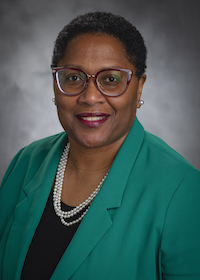

Rev. Marilyn J. D. Barnes, MS, MA, MPH, BCC (left) and Kelsey B. White, Ph.D., BCC (right)
Members of the inaugural cohort included Rev. Marilyn J. D. Barnes, MS, MA, MPH, BCC, Rev. Robert B. Lantz chair and associate professor in the Department of Patient Counseling, and associate professor Kelsey B. White, Ph.D., BCC. Barnes was encouraged by Fitchett to apply. At the time, she was part of a research team developing a normative language for chaplains, which did not exist.
“It was overwhelming and exhilarating all at the same time, and the Transforming Chaplaincy Fellowship was life and career changing for me,” Barnes said.
White said her son was born the same year she joined the inaugural fellowship and noted that the organization has grown alongside her family.
“It's a real visual marker of time passing, and a reminder of the things we’ve accomplished,” White said.
How the group has affected chaplaincy
White said she is enthusiastic about the organization's overall growth, which has brought more energy to evidence-based spiritual care.
“It makes me so excited to see the creative, innovative ideas that come from chaplains who are now just thinking research is an everyday part of our clinical practice, as compared to when I started, and research was this new shiny object,” White said. “People weren't talking about research, people didn't engage with research articles, and now it is just a really consistent part of our practice.”
White also noted that the initial cohort aimed to help fund 16 chaplains to pursue master's degrees in public health, further building their research skills. White notes that the cohorts have gone above and beyond, with most of the original members going on to earn their Ph.D.’s.
“That was never in the plan, and so not only did it increase research literacy, as well as interest in research, it actually produced researchers,” White said.
Barnes notes that Transforming Chaplaincy has really helped advance evidence-based research, shape the growth of chaplaincy education, and make the field more diverse.
“It's really (help build) evidence-based practice, more research-informed, collaborative and diverse (research),” Barnes said. “(Before Transforming Chaplaincy) it was sociologists, psychologists, and nurses conducting research in spirituality and not the chaplain, so that has changed a lot.”
Tartaglia noted that the organization has become a “magnet” for researchers to come together and connect with like-minded peers in the field. He also mentioned that Transforming Chaplaincy has continued to offer research literacy courses for chaplains and CPE programs.
“Not every CPE program has the resources to have a member of its team or staff who's sufficiently trained in research to be able to teach it, so it continues to offer those programs,” he said.
Effect on thought leadership
While the organization has certainly been focused on research, it has also become better connected with health systems and has emerged as a leader in the field of spiritual care. Transforming Chaplaincy already partners with major systems, including Cedars-Sinai, Providence St. Joseph’s Health, and Indiana University Health. Barnes adds that Transforming Chaplaincy has also expanded its reach beyond the United States, working with counterparts in Europe to expand chaplaincy research.
“George (Fitchett) is constantly pulling others in and finding new ways to bring more voices to the table. That’s how we continue to grow and evolve the field,” Barnes said. “We’re asking: what is the true impact of treating spiritual health as a social driver of health, and how do we train chaplains to demonstrate how spiritual health advances the quadruple aim in health care? Much of that is Kelsey’s work, and the work of many others, as we explore the right size of spiritual care departments, the skills chaplains need, and how we map those competencies in a way that makes sense for the future.”
Historically, chaplains have looked for ways to demonstrate their impact and value to hospital leaders and administrators who may have varying degrees of understanding the role of professional spiritual care. Transforming Chaplaincy has continued to support those efforts through outcome based research.
“One of the key things that chaplains spend a lot of time doing is staff care, and staff well-being is very important to the hospital administrators. It is not surprising therefore that transforming chaplaincy and its research colleagues are trying to assess what level of staff care chaplains are providing, what activities they offer to promote staff care, and what services they provide to promote staff well-being,” Tartaglia said.
The future
Today Transforming Chaplaincy continues to support and collaborate with our VCU team in producing published research in areas such as spiritual care department benchmarking and the professional chaplaincy workforce. According to Barnes, the future of Transforming Chaplaincy and its connections to CHP continues to look bright. Barnes is working with the group to hold an actual think tank at VCU, where the university will host chaplain researchers and spiritual care department leaders to map future research sometime in the spring of 2027.
“The research strategy is based upon where health care is going; how we are driving spiritual care interventions; where we're driving education,” and “what we want to measure,” she said.
Transforming Chaplaincy will also continue to produce courses and webinars to help inspire and direct the next generation of research and thought leadership.
“TC has really ignited energy around evidence-based care and spiritual care,” White said. “I love seeing the creative, innovative ideas that come from chaplains who are now (focusing on) research as an everyday part of our clinical practice. I am hopeful the energy will continue to build with VCU’s leadership,” White said.