Jan 29, 2026
Transfusion Services Summer Scholars gives students a hands-on look at lifesaving lab careers

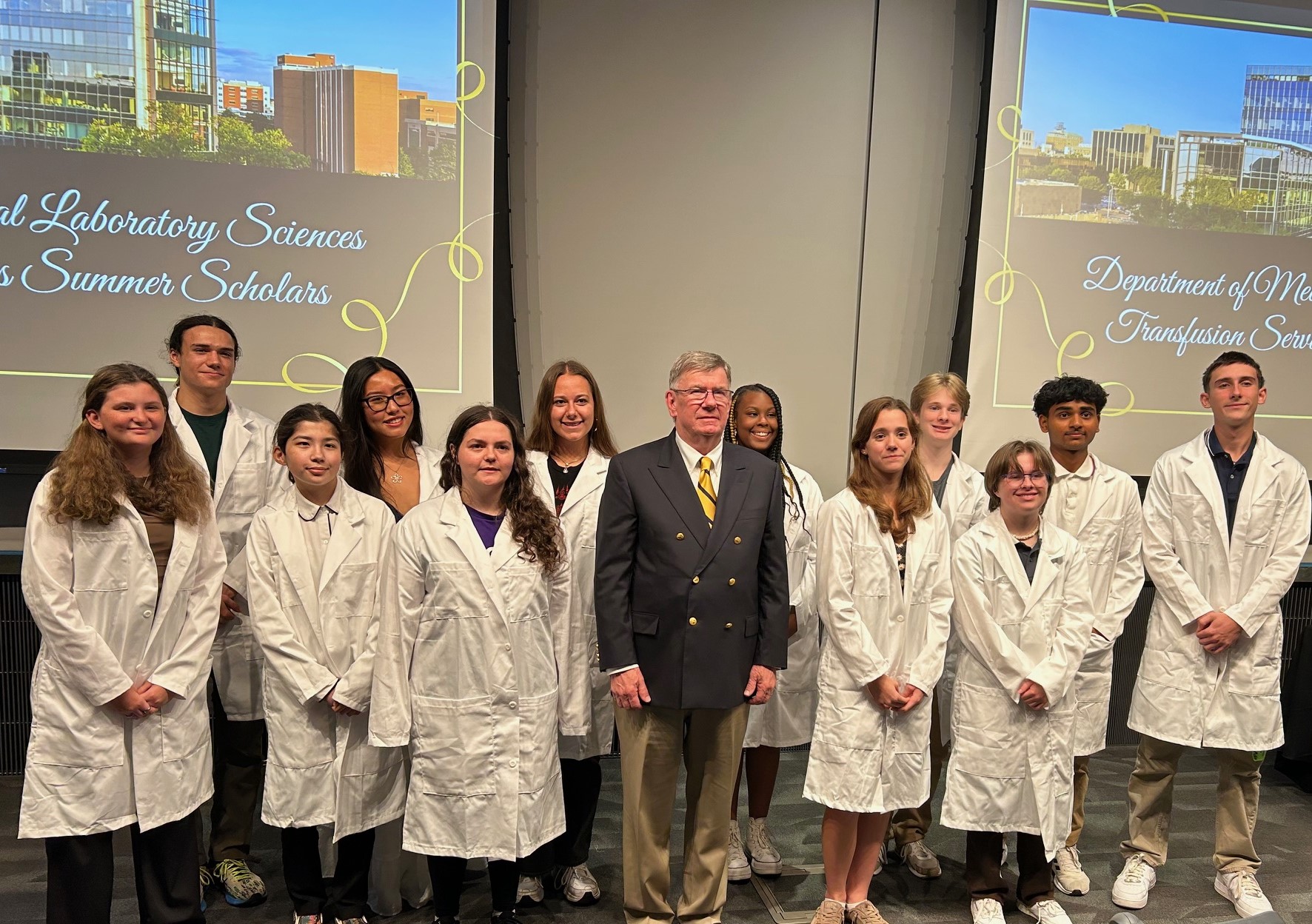
For one week in July, high school and college students from across the country stepped into the fast-paced, high-stakes world of transfusion medicine at Virginia Commonwealth University.
Hosted by VCU’s Department of Medical Laboratory Sciences in the College of Health Professions, the inaugural Transfusion Services Summer Scholars program immersed participants in the science and practice behind safe blood transfusions – an essential but often unseen part of patient care. Supported by the Commonwealth Transfusion Foundation, the July 14-18 program was fully funded, covering housing, meals and a $500 stipend for each student.
Throughout the week, students explored the fundamentals of blood banking, including ABO and Rh blood typing, antibody detection, phenotype determination and compatibility testing. Through hands-on lab sessions, case studies and tours of working clinical laboratories, participants connected classroom science to real-world hospital decision-making – seeing how laboratory professionals support everything from trauma care to cancer treatment.
For many students, the experience clarified both academic interests and career possibilities.
“I really learned a lot from this program, and it was an amazing experience to meet students who share the same interests and views,” said one high school junior planning to study STEM or law. “Applying things in labs and seeing their relevance in hospitals was especially interesting.”
Another participant, a junior considering a medical career, said the program had a lasting impact.
“I truly think this program created a difference for me,” the student said. “It was such a unique experience – something you could only imagine where I live. Participating in it changed my perspective, gave me a better understanding of what VCU is, and even put it on my college radar.”
Students cited a wide range of skills and knowledge gained during the week, from blood smears, staining and immunophenotyping to understanding why transfusing the wrong blood type can be life-threatening. Others noted a deeper appreciation for how chemistry, biology, hematology and immunology intersect in clinical laboratory science—and how lab professionals play a critical role in supporting physicians and patient care teams.
Melissa Jamerson, Ph.D., chair of the Department of Medical Laboratory Sciences, said the program delivered exactly the kind of impact organizers hoped for.
“By the end of the week, students weren’t just learning techniques. They were thinking like laboratory professionals,” Jamerson said. “They understood how critical these decisions are in real patient care, and many left seeing medical laboratory science as a meaningful and viable career path. That awareness is a powerful first step for the future of our workforce.”
The need for that workforce is urgent. Transfusion medicine and other laboratory science disciplines face a national shortage as retirements outpace new entrants, even as advances in testing and growing patient needs increase demand.